Kateřina Vincourová
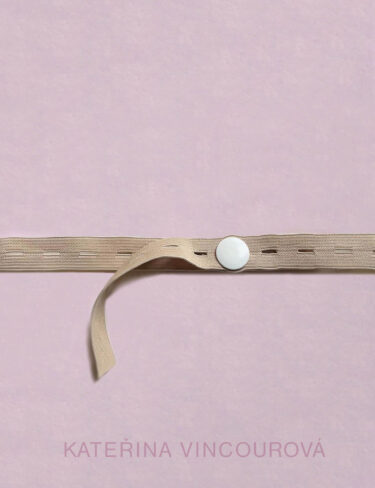
The monograph Kateřina Vincourová was published by Galerie Rudolfinum in its editorial series on the occasion of a major solo exhibition of this Czech artist, which it organized under the title Kateřina Vincourová Skin Care from October 2, 2025, to January 11, 2026. The publication includes a text and an extensive interview with the artist by exhibition curator Denisa Kujelová, as well as essays by Martina Pachmanová (UMPRUM), Vít Havránek (AVU), and British art historian Klara Kemp-Welch. The monograph was designed by photographer and graphic artist Markéta Othová, with installation photographs by Martin Polák. The publication not only captures the exhibition itself, but also comprehensively covers Kateřina Vincourová’s work from the 1990s to the present day, including rich visual materials.
Kateřina Vincourová (*1968) studied at the V. I. Surikov Academy of Fine Arts in Moscow (1986–1988) and then at the Academy of Fine Arts in Prague (1988–1994). She has held scholarships at the DAAD in Berlin and the Headlands Centre for Art in California. In 1993 she was awarded the Alexander Dorner Prize in Hanover and in 1996 the Jindřich Chalupecký Prize. In her work, she focuses primarily on installation art and object art, often incorporating atypical materials and everyday objects. Along with the mutability of aspects of identity and relationships, she also explores the possibilities of space and its ambiguities. Her solo exhibitions include the American University Museum at the Katzen Arts Center in Washington, DC (2018), Fait Gallery in Brno (2016), the Centre for Contemporary Art in Warsaw (2001), Météo Gallery in Paris (1997), and Galerie Behémót in Prague (1992). She has also participated in a number of group exhibitions, such as Bittersweet Transformation at Kunsthaus Graz (2016), In a Skirt – Sometimes at GHMP and Moravian Gallery in Brno (2014), After the Wall at Moderna Museet in Stockholm (1999) and Home Sweet Home at Diechtorhallen in Hamburg (1997). Her works are housed in significant national and public institutions and private collections.
- Editors Julia Tatiana Bailey, Eva Drexlerová, Denisa Kujelová
- Price 890 CZK
-
More information
Galerie Rudolfinum, Prague, 2025
159 pages
English
ISBN 978-80-86443-72-0
Texts: Vít Havránek, Klara Kemp-Welch, Denisa Kujelová, Martina Pachmanová, Kateřina Vincourová
Design, Layout, and Typesetting: Markéta Othová
Translation: Becka McFadden, Eva V. Ullrichová - Exhibition